Mental rehearsal
Personal Patterns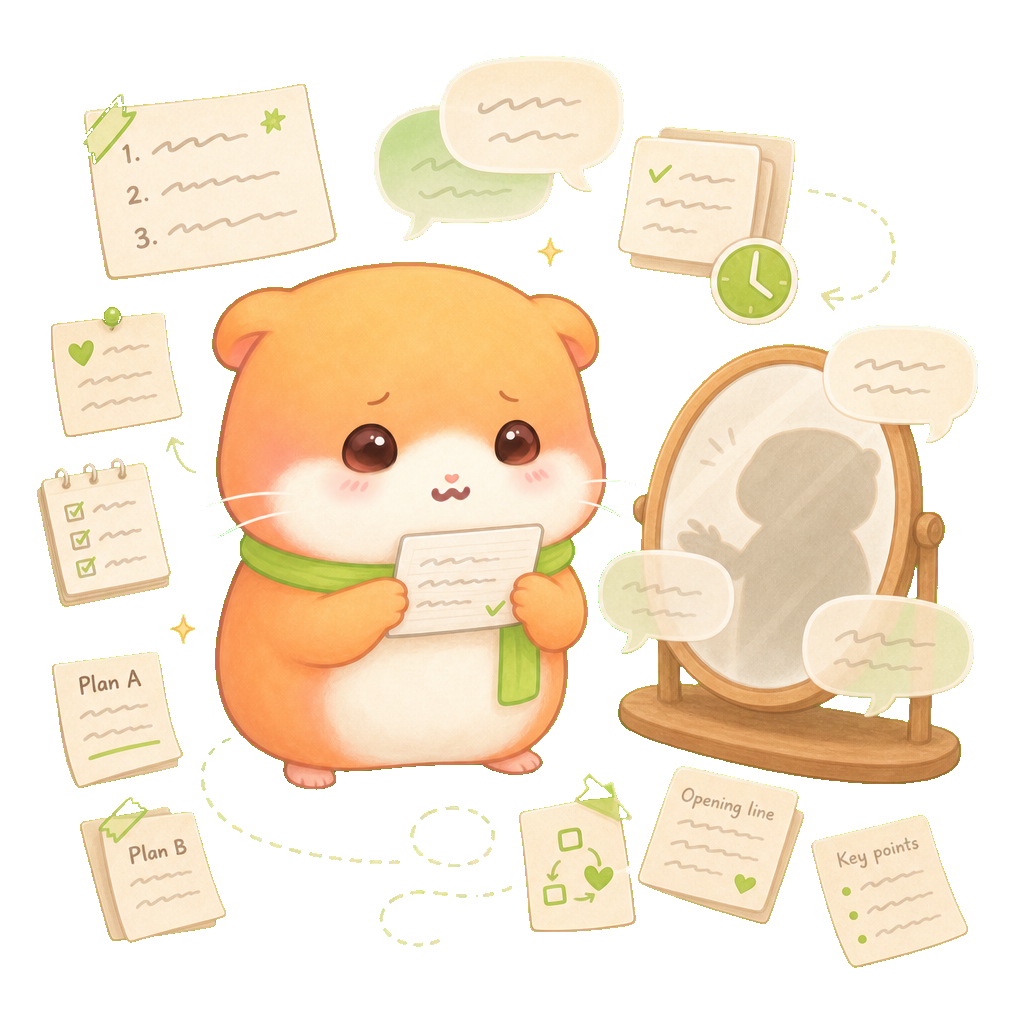
What is it?
Mental rehearsal is when you repeatedly practice future conversations, arguments, explanations, decisions, or scenarios in your head. Some rehearsal is useful, especially before something important. But it becomes a pattern when you keep rehearsing because you’re trying to eliminate uncertainty, avoid being caught off guard, or protect yourself from regret. The problem is that real situations rarely follow the exact script, so too much rehearsal can make you more rigid, more anxious, and more attached to controlling how things unfold.
How do people work on it?
Instead of rehearsing every possible version, try preparing only the anchor points. Ask: What are the two or three things I actually need to communicate or remember? Write those down, then stop. The goal is to trust yourself to respond in the moment rather than trying to pre-live the whole event.
A useful exercise: make a three-line script. Write: What I want to say, what I need to ask, and what boundary or decision matters. Once you have those, don’t keep polishing the imagined conversation. Practice tolerating the fact that the real version will be partly unscripted.
Additional resources to explore: CBT and ACT can both help here. CBT can target the belief that you must rehearse perfectly to cope. ACT can help you accept uncertainty and act from your values, even when the conversation can’t be fully controlled. If mental rehearsal is part of social anxiety or conflict anxiety, exposure-based work may also be useful.
Educational, not diagnostic.
Learn more