All-or-nothing thinking
Personal Patterns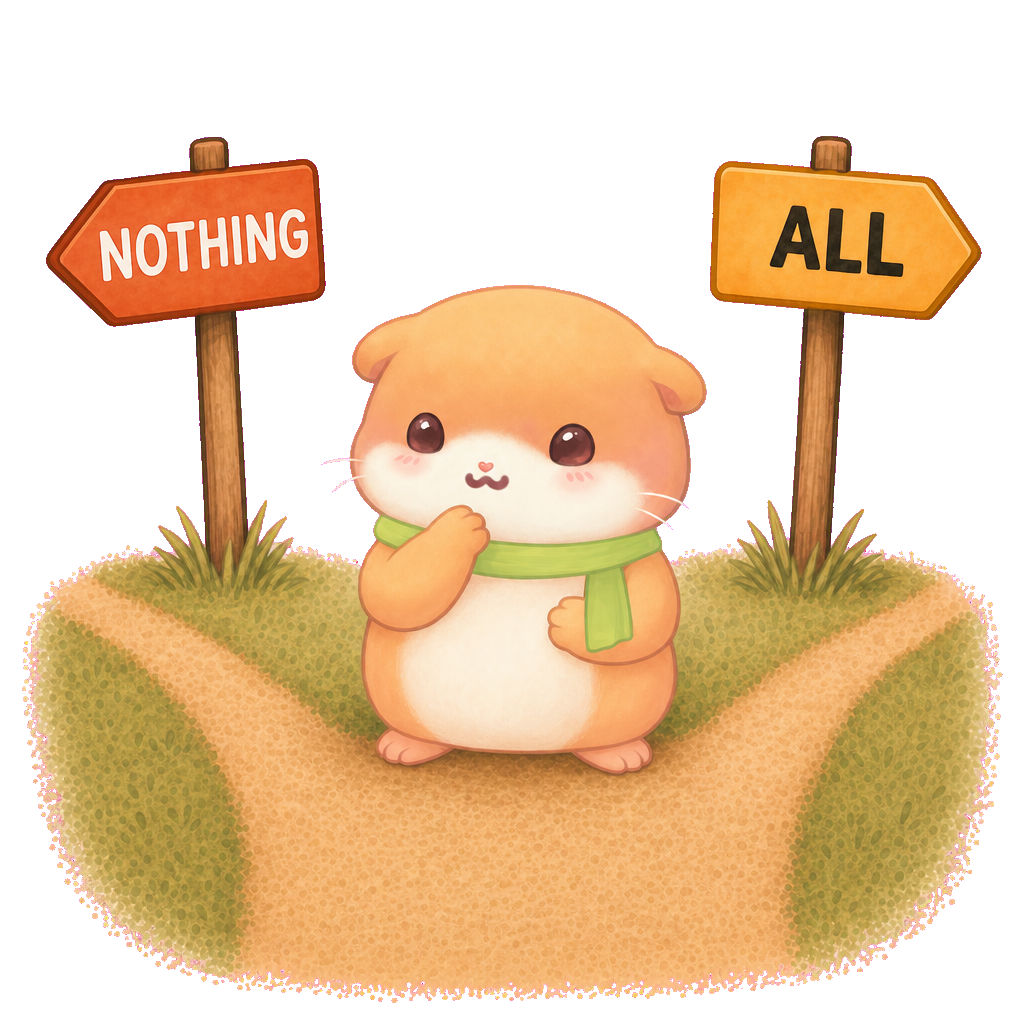
What is it?
All-or-nothing thinking is when your mind sorts experiences into extremes: success or failure, good or bad, perfect or ruined, worthy or worthless. It can create a lot of pressure because anything short of the ideal starts to feel like total collapse. This pattern often shows up when emotions are high, when you care deeply about something, or when you’re afraid of making mistakes. The problem isn’t that you have standards. It’s that your mind erases the middle, where most real life actually happens.
How do people work on it?
The skill here is to practice finding the middle. Instead of asking, “Was this good or bad?” ask, “What percentage true is this?” or “What parts worked and what parts didn’t?” Try rating the situation on a 0–100 scale rather than using either/or language. For example, “I completely failed” might become “That was 40% messy, 60% okay, and there’s one thing I’d do differently next time.” The goal isn’t to lower your standards. It’s to make your thinking more accurate.
A useful exercise: use a middle-ground rewrite. Write the extreme thought first, then rewrite it with nuance. Extreme: “I ruined everything.” Middle-ground: “I made one mistake, and I can still repair or improve the situation.” This helps your brain practice seeing partial success, partial failure, and realistic next steps.
Additional resources to explore: CBT cognitive restructuring is especially useful for all-or-nothing thinking because it helps you identify extreme thoughts and replace them with more balanced ones. ACT can also help if the thought keeps showing up even after you know it isn’t fully accurate.
Educational, not diagnostic.
Learn more